

KEY TAKEAWAYS
- ADGM introduced Consultation Paper 11 of 2024, proposing significant amendments to its Virtual Assets framework to address risks and promote growth.
- New prohibitions include algorithmic stablecoins, privacy tokens, and similar technologies. FSRA can now halt certain Virtual Asset activities if they contravene regulations or ADGM’s interests.
- Authorised Persons can self-assess Virtual Assets against detailed criteria, including maturity, security, traceability, and innovation. Notifications must be submitted to FSRA, which will accept or reject within 20 days.
- Firms providing custody for Virtual Assets must maintain higher capital reserves (26/52nds of annual audited expenditure), enhancing stability and investor protection.
- A unified application and supervision fee structure reduces costs for firms conducting multiple Virtual Asset activities, promoting operational efficiency.
- VC Funds can now invest in Virtual Assets, governance tokens, and utility tokens, fostering blockchain innovation while adhering to early-stage investment criteria.
- Proposed classifications distinguish between regulated and non-regulated staking models. Pool operators and intermediaries must obtain licences for custody or asset management services.
- FRTs are defined as stable digital assets tied to fiat currency. The FSRA will distinguish FRTs from Virtual Assets and assess foreign FRTs against domestic standards.
- ADGM’s proposed amendments aim to enhance transparency, safety, and compliance while fostering innovation in Virtual Asset markets.
INTRODUCTION
Regulations related to Virtual Assets[1] are undergoing seismic changes worldwide to address risks and promote growth. The Abu Dhabi Global Market (“ADGM“) opened comments for Consultation Paper 11 of 2024[2] and has proposed pivotal amendments to its existing framework for Virtual Assets.
SUMMARY OF THE PROPOSED AMENDMENTS
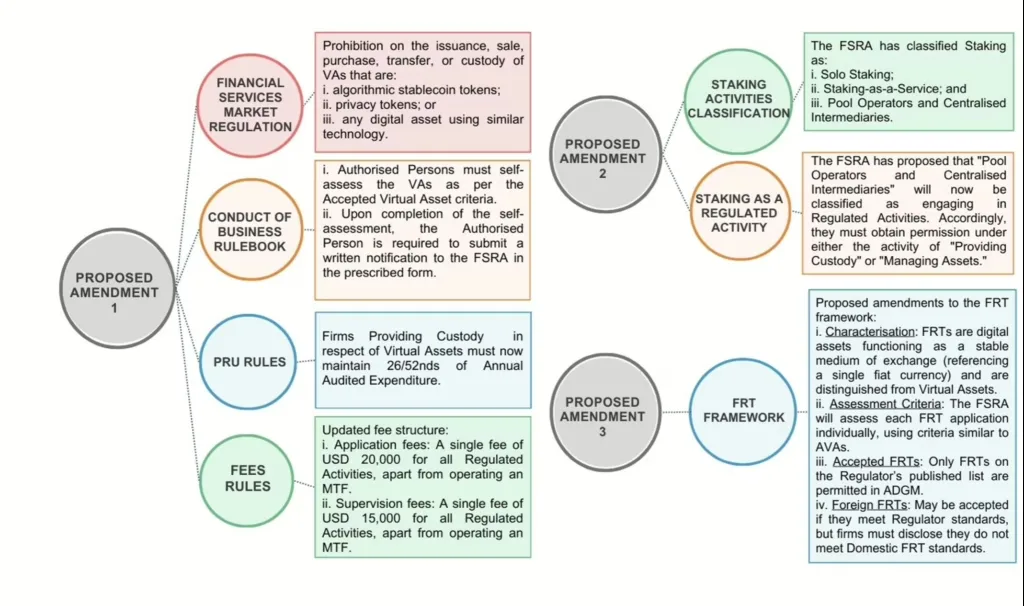
PROPOSED AMENDMENT 1: SUGGESTED AMENDMENTS TO THE VIRTUAL ASSETS FRAMEWORK
Below, we have analysed all the proposed changes and outlined their implications:
| Topic | Previous Position | New Position | Comments |
|---|---|---|---|
| Section 5A – Prohibition on Certain Virtual Assets and the Regulator’s Power to Issue Directions | Prohibition on algorithmic stablecoins or privacy tokens, and the Financial Services Regulatory Authority’s (the “Regulator”) power to halt dealings in certain Virtual Assets were not explicitly addressed under the previous framework. | A new prohibition is proposed, barring the issuance, sale, purchase, transfer, or custody of Virtual Assets that are: i. Algorithmic stablecoin tokens; ii. Privacy tokens; or iii. Any digital asset using similar technology. The FSRA now has the authority to issue a direction to halt dealings in particular Virtual Assets activities if it deems that the transaction would contravene the Financial Services and Markets Regulations (the “Regulations”) or is in the interests of the ADGM. | The proposed changes target certain digital assets considered higher risk, such as algorithmic stablecoins—digital tokens designed to maintain a stable value through automated mechanisms—and privacy tokens, which are designed to obscure transaction details and make tracing difficult. Additionally, the FSRA will now have the authority to issue directions to halt certain dealings in Virtual Assets activities. These measures aim to create a safer and more transparent environment for digital assets. |
| Topic | Previous Position | New Position | Comments |
|---|---|---|---|
| Rule 17.2 – Criteria and Process for Accepted Virtual Assets | i. Only Accepted Virtual Assets (“AVA”)3 were allowed to be used by an Authorised Person4 conducting Regulated Activities.5 ii. The FSRA determined whether a Virtual Asset qualifies as an AVA based on: a. Maturity/market capitalisation threshold; and b. Other relevant factors outlined in accompanying guidance published by the regulator. | i. Authorised Persons can now self-assess Virtual Assets against detailed AVAs criteria, including: a. Maturity/market capitalisation; b. Security; c. Traceability/monitoring; d. Exchange connectivity; e. Type of distributed ledger technology; f. Innovation/efficiency; and g. Practical application/functionality. ii. Upon completion of the self-assessment, the Authorised Person is required to submit a notification to the FSRA in the prescribed format. iii. The FSRA shall accept or reject the inclusion in the AVA list within 20 (twenty) days and if no response is received from the FSRA, the Virtual Asset shall be deemed to be an AVA. iv. Authorised Persons must continuously monitor AVAs to ensure ongoing compliance with the criteria. | Previously, the FSRA was solely responsible for assessing and approving Virtual Assets as Accepted Virtual Assets through a two-stage Regulator-led process based on established AVA criteria. Under the proposed changes, Authorised Persons will self-assess Virtual Assets against detailed AVA criteria, allowing for greater flexibility and a risk-based approach. However, it also introduces new challenges, as the virtual asset service providers must implement robust internal systems to ensure compliance and continuous monitoring. |
| Topic | Previous Position | New Position | Comments |
|---|---|---|---|
| Rule 3.7.1 – Expenditure Based Capital Minimum | The capital requirement for Authorised Persons were set based on their activities: i. Category 3C6 issuing FRT (as defined): 1 year of annual audited expenditure. ii. Holding Client Assets7 / relevant insurance money: 18/52nds annual audited expenditure. iii. Category 3B or 3C without Client Assets: 13/52nds of Annual Audited Expenditure. iv. Category 4 without Insurance Money: 6/52nds of Annual Audited Expenditure. | i. Firms Providing Custody8 in respect of Virtual Assets must now maintain 26/52nds of Annual Audited Expenditure. ii. Requirements for other Authorised Persons remain unchanged: a. Holding Client Assets / relevant insurance money: 18/52nds of annual audited expenditure. b. Category 3B or 3C without Client Assets: 13/52nds of annual audited expenditure. c. Category 4 without insurance money: 6/52nds of annual audited expenditure. | The revised capital requirements for companies Providing Custody services in respect of Virtual Assets significantly increase the minimum expenditure-based capital to 26/52nds of annual audited expenditure. This change reflects a more cautious regulatory approach to custody services. By requiring custodians to maintain greater financial reserves, the ADGM aims to enhance the stability and resilience of firms handling Client Assets, ensuring better protection for investors. Meanwhile, the unchanged requirements for other firms indicate a tailored approach, maintaining proportionality across different categories of activities. |
| Topic | Previous Position | New Position | Comments |
|---|---|---|---|
| Rule 3.17 – Fees for Virtual Asset Regulated Activities | Under the previous framework, applicants were charged through the following fee structure: i. Application Fees: $20,000 for each Regulated Activity or $125,000 if the Regulated Activity was Operating a Multilateral Trading Facility (“MTF”) without additional Regulated Activities. ii. Supervision Fees: $15,000 per Regulated Activity or $60,000 if the Regulated Activity was Operating an MTF without additional activities. | The new version simplifies the fee structure: i. Application Fees: A single cumulative fee of $20,000 applies for all Regulated Activities related to Virtual Assets, unless one of the activities involves Operating an MTF. In that case, a fee of $125,000 applies. ii. Supervision Fees: A single cumulative fee of $15,000 applies for all Regulated Activities related to Virtual Assets unless one of the activities involves Operating an MTF. In that case, the fee is $60,000. | The previous framework charged fees for each Regulated Activity, which could result in higher costs for firms undertaking multiple activities. The new simplified fee structure introduces a single fee for all Regulated Activities related to Virtual Assets. This change reduces the financial burden on firms conducting multiple activities, promoting operational efficiency. |
| Topic | Previous Position | New Position | Comments |
|---|---|---|---|
| Rule 4.1.6 – Venture Capital Fund | Previously, Venture Capital Funds (“VC Funds”) could only invest in securities of early-stage companies that were not listed or admitted to trading on an exchange. | The new definition expands investment scope to include: i. Virtual Assets and instruments enabling the acquisition of Virtual Assets or securities. ii. Governance tokens for on-chain project participation. iii. Utility tokens for using crypto project services or products. iv. Digital tokens representing value or rights to acquire such tokens. All issuances must still be by companies at an early development stage. Structural requirements remain unchanged (closed-ended, subscription limits, and fund eligibility criteria). | The expanded definition allows VC Funds to invest in Virtual Assets, governance, and utility tokens, fostering innovation in blockchain projects while the unchanged core requirements ensures alignment with the original purpose of VC Funds. |
PROPOSED AMENDMENT 2: SUGGESTED AMENDMENTS FOR STAKING AS A REGULATED ACTIVITY
Below is an overview of the changes proposed for the Staking.[9]
| Topic | Previous Position | New Position | Comments |
|---|---|---|---|
| STAKING RELATED ACTIVITIES | |||
| Staking Business Models | Staking activities were not explicitly addressed or regulated under the framework. | To determine whether the Staking will fall under the scope of a Regulated Activity, FSRA has proposed the following two key factors: i. Level of intermediation: Whether the intermediary has control over or discretion over the staked Virtual Assets. ii. Extent of business activity: Whether Staking activities are carried out for non-related participants. | This change is a significant step towards recognising Staking as a Regulated Activity itself. These factors influence the final classification in which a service provider would fall (as expanded below). |
| Classification of Staking Activities | The FSRA has suggested the following classifications for staking: i. Solo Staking: Not a Regulated Activity as participants operate without intermediation and stake on their own account. ii. Staking-as-a-Service: Not a Regulated Activity if the service provider only offers technical services to set up, operate, and maintain infrastructure without controlling participants’ Virtual Assets. The participant selects the validator and stakes on their own account. iii. Pool Operators and Centralised Intermediaries: Entities in this category must obtain official permission to carry out a Regulated Activity under either Providing Custody or that of Managing Assets10. | The proposed classifications for staking activities introduce clarity by distinguishing between non-regulated and regulated Staking models. Since service providers of Staking either hold custody of the staked Virtual Assets or have decision-making authority over how these assets are used, these two categories of service providers shall be required to obtain a licence. | |
PROPOSED AMENDMENT 3: SUGGESTED AMENDMENTS FOR THE FRT REGIME
We have previously analysed the changes introduced to the FRT regime through Consultation Paper No. 7 of 2024.[11] In the table below, we aim to analyse the changes brought through Consultation Paper No. 11 of 2024. The proposed updates to the fiat-referenced tokens (“FRTs“) regime introduce clearer distinctions and stricter requirements to align with the Regulator’s standards. Key changes include:
| Topic | Previous Position | New Position | Comments |
|---|---|---|---|
| FRT FRAMEWORK | |||
| FRT Regime under the ADGM Framework | Currently, the issuance of FRTs is governed by Chapter 19A of the Conduct of Business Rulebook, requiring compliance with specific rules such as white paper submission, reserve asset management, and redeemability. FRTs accepted within ADGM were treated uniformly, without a distinction between domestic FRTs (issued locally) and foreign FRTs (issued outside ADGM). Authorised Persons conducting Regulated Activities involving FRTs are required to use only “Accepted FRTs.” These are assessed under the same seven criteria used for AVAs, including maturity, security, traceability, exchange connectivity, type of distributed-ledger technology, innovation, and practical application. | The proposed changes to the FRT framework involve: i. Characterisation of FRTs: FRTs are recognised as digital assets designed to function as a stable medium of exchange, typically referencing a fixed amount of a single fiat currency. Unlike virtual assets, FRTs are not considered investments but rather tools for transactions. As such, the FSRA now intends to distinguish FRTs from Virtual Assets based on their function as a stable medium of exchange. ii. Assessment Criteria: The FSRA will conduct individual assessments for FRT acceptance, applying criteria similar to those for AVA. iii. Accepted FRTs: Only Accepted FRTs can be used in ADGM, identified on a list published by the Regulator. iv. Acceptance of Foreign FRTs: Foreign FRTs may be accepted but must meet Regulator’s standards. Firms using these must disclose that such FRTs do not meet Domestic FRT standards. | The FSRA aims to further enhance and solidify its FRT framework by proposing these amendments. The FSRA is now inclined to allow more Virtual Assets, as evident from the acceptance of the Tether to the VA list12 and the inclusion of the issuance of FRTs as a Regulated Activity13. This makes ADGM an exciting jurisdictions for all business thinking to conduct any activity pertaining to FRTs – issuance, management or otherwise. |
HOW TLP ADVISORS CAN ASSIST?
At TLP Advisors, we are a forward-thinking consulting, strategy, and law firm specialising in solutions for the financial services, gaming, Web3, and emerging tech sectors. With deep expertise in these industries, we provide tailored support to address their unique challenges.
Our team has extensive experience providing advisory support to clients navigating the ADGM framework. From assisting with company incorporation within ADGM to guiding businesses through its complex regulatory landscape and licensing, we offer comprehensive services to ensure our clients achieve compliance and success in this dynamic environment.
CONCLUSION
The proposed changes to ADGM’s Virtual Asset framework reflect a forward-thinking approach that balances innovation with regulatory vigilance. By addressing emerging risks, streamlining processes, and introducing clear guidelines for activities like Staking and Virtual Asset custody, ADGM aims to create a secure and dynamic environment for market participants. These amendments enhance compliance standards and open up new opportunities for businesses and investors within the evolving digital asset landscape.
***
DISCLAIMER: This article is provided for informational and educational purposes only and does not constitute legal advice. Readers should not act upon this information without seeking professional legal counsel tailored to their specific circumstances. The analysis presented herein reflects the authors’ interpretation of legal developments as of the date of publication and may not reflect subsequent changes in law or regulation.
At TLP Advisors, we are a legal consulting firm specialising in tokenised finance, agentic financial systems, digital assets, and emerging technologies. With deep roots in the financial services, Web3, and broader technology sectors, we offer unparalleled expertise and tailored support to navigate the unique challenges and opportunities of these rapidly evolving industries. TLP Advisors has consistently been the firm of choice for web3, fintech and other financial services companies. We have built a reputation for guiding clients through complex regulatory landscapes while supporting the development of innovative and compliant financial platforms.
***
[1] Virtual Assets refers a digital form of value that can be traded online and serves as a medium of exchange, a unit of account, or a store of value. Virtual assets are distinct from fiat currency and electronic money.
[2] Consultation Paper No. 11 of 2024, Proposed Amendments to the Digital Asset Regulatory Framework, The Financial Services Regulatory Authority, ADGM (05 December 2024), https://assets.adgm.com/download/assets/Consultation+Paper+No.+11+of+2024+-+Proposed+Amendments+to+the+Digital+Asset+Regulatory+Framework.pdf/3acc8760b2f411ef8da15eec0cc5c1b0.
[3] Accepted Virtual Asset means a Virtual Asset that, in the opinion of the Regulator, meets the requirements for an Authorised Person conducting a Regulated Activity in relation to Virtual Assets.
[4] Any individual who was the financial services permission by the FSRA to carry on one or more Regulated Activities.
[5] Regulated Activities refers to the following activities undertaken in relation to Virtual Assets: a) Dealing in Investments as Principal; b) Dealing in Investments as Agent; c) Advising on Investments or Credit; d) Arranging Deals in Investments; e) Managing Assets; f) Providing Custody; g) Arranging Custody; and h) Operating a Multilateral Trading Facility.
[6] An Authorised Person providing either of the following Regulated Activities: (i) Managing Assets; (ii) Managing a Collective Investment Fund; (iii) Providing Custody (where it does so other than for a Fund); (iv) Managing a Profit Sharing Investment Account which is a PSIAr; (v) Providing Trust Services (where it is acting as trustee in respect of at least one express trust); (vi) Providing Money Services; or (vii) Issuing a Fiat-Referenced Token.
[7] Client Asset means any money or investments that an authorised person holds or manages on behalf of a client as part of their business activities.
[8] Providing Custody means holding or safeguarding financial instruments, Virtual Assets, spot commodities, or fund property on behalf of others, including managing or administering those assets.
[9] Staking is a process by which users or participants of a blockchain network or protocol participate in a Proof-of-Stake consensus mechanism.
[10] Managing Assets means managing, on a discretionary basis, assets belonging to another person, including financial instruments, virtual assets, spot commodities, or rights under a contract of long-term insurance (excluding reinsurance).
[11] Please find our previous article on the initial consultation paper here.
[12] Please read more on this at: https://www.crypto-news-flash.com/tethers-usdt-gains-ava-status-in-abu-dhabis-financial-hub/
[13] Please find our previous article of the inclusion of FRT issuance as a Regulated Activity here.